Reading the Journals of Younghusband
The overstuffed bed of the Seman Hotel in Kashgar was a luxury after a 30+ hour bus ride along the edge of the Taklamakan Desert. The lighting in the room was low, with shadows adding more complexity to the fancy moulding and cornices. I read Peter Hopkirk while leaning on a mountain of pillows.
Prior to becoming a hotel in 1950, the building served as the embassy of the Russian empire in the 19th century. Just across the road was the British embassy where at the end of the 19th Century the British explorer Sir Francis Younghusband stayed. Here in the Seman Bronislav Grombchevsky would have enjoyed quarters significantly better than his tent in the mountain passes of Central Asia. Gromchevsky was Captain Younhusband’s Russian counterpart in The Great Game, the competition between the British and Russian empires for control over Central Asia.
In the late 19th century Imperial explorers trekked the Himalayan and related mountain ranges, mapping potential passes and routes that could be of advantage for their particular empire. Russia wanted to take India, the crown jewel of the British empire away. The British empire wanted a series of friendly buffer states to protect its “possession”. Often the explorers knew one another, and would even run into one another to share a meal. Younghusband records his first encounter with Grombchevky in his journal of 1899:
Oct 23. March to Khan-akzai & met Grombtchevsky & found him to be a very good sort of fellow & it was a decided pleasure having a European to talk to. I have written all the important information about him in a letter to Col Nisbet [?]. He lived in a small sort of umbrella tent just large enough to hold a light camp bed. He was in uniform . a peaked cap with a red band, a long brown sort of overcoat lined with fur & buttoning tight across the chest — pantaloons with a thin red stripe like our Infantry, & long boots. He is a fine tall good looking man & says he is a Pole by birth. There is with him a German naturalist named Conrad.
Last month I had the pleasure of reading those words as written by the hand of Younghusband himself, in his journals kept in the Royal Geographical Society in London.
One hundred years after that fateful meeting in the mountain passes of the Pamirs I spent a lot time reading about adventurers crossing the roof of the world. I had a bit of an obsession with the explorer Younghusband, using that name as a pseudonym on the web. In 2004 I had the pleasure of visiting the Pamir Plateau myself, seeing the same red mountains that Younghusband commented on more than a century earlier (see some photos from Chinese Turkestan here). A couple of years after my trip a friend gifted me a 1936 copy of Younghusband’s book Everest: The Challege as a wedding present.
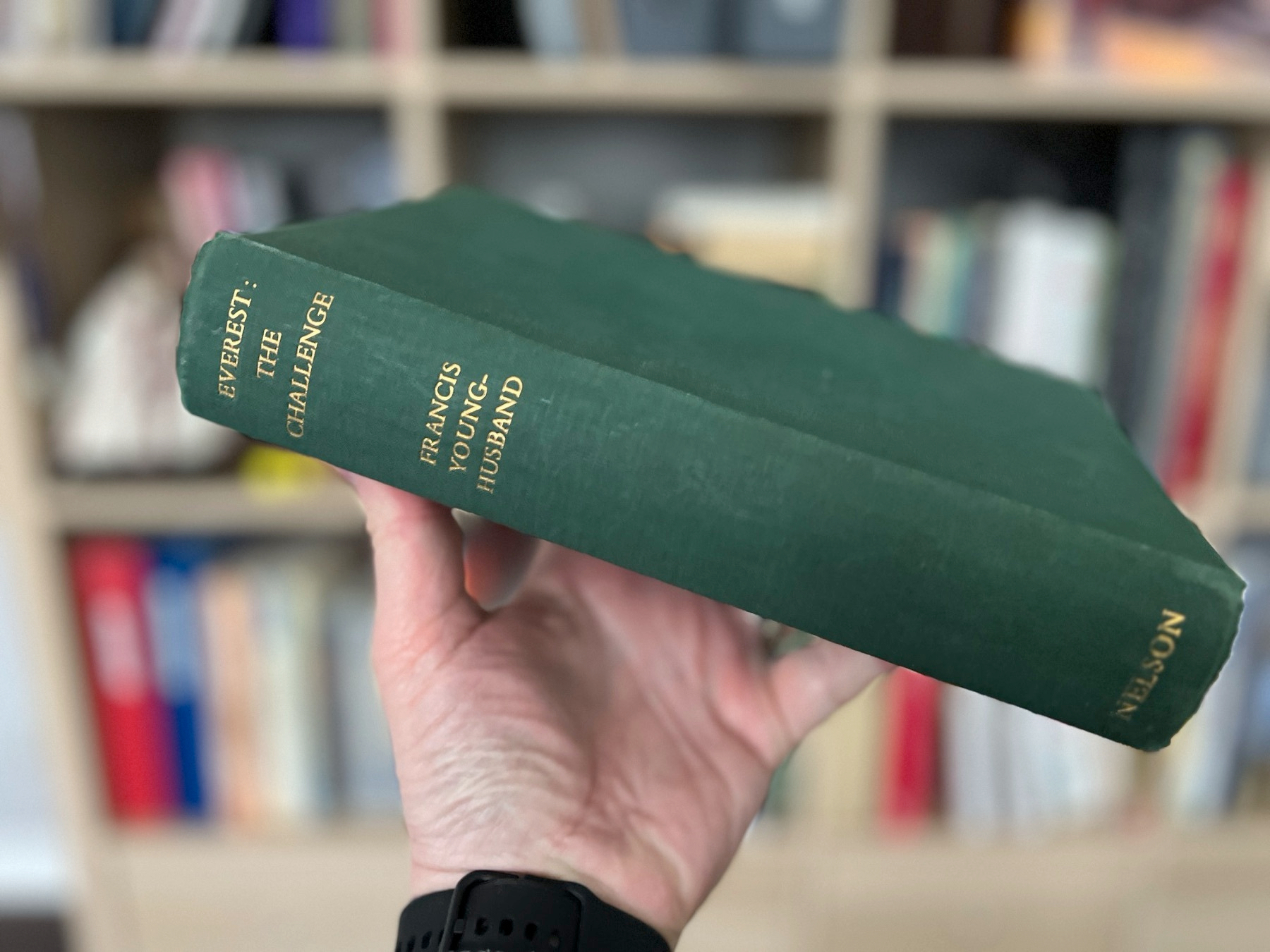
Patrick French’s biography of Younghusband showed how much of a complex character he was, turning from imperialist adventurer to a spiritualist. I read that book with envy as French retraced Younghusband’s steps over high mountain passes.
I knew that Younghusband had gifted many of his personal items to the Royal Geographical Society, which he held so dear. One day, I thought, I will journey to London and see journals myself. Last month, I was able to tick that particular item off my bucketlist.
At the RGS
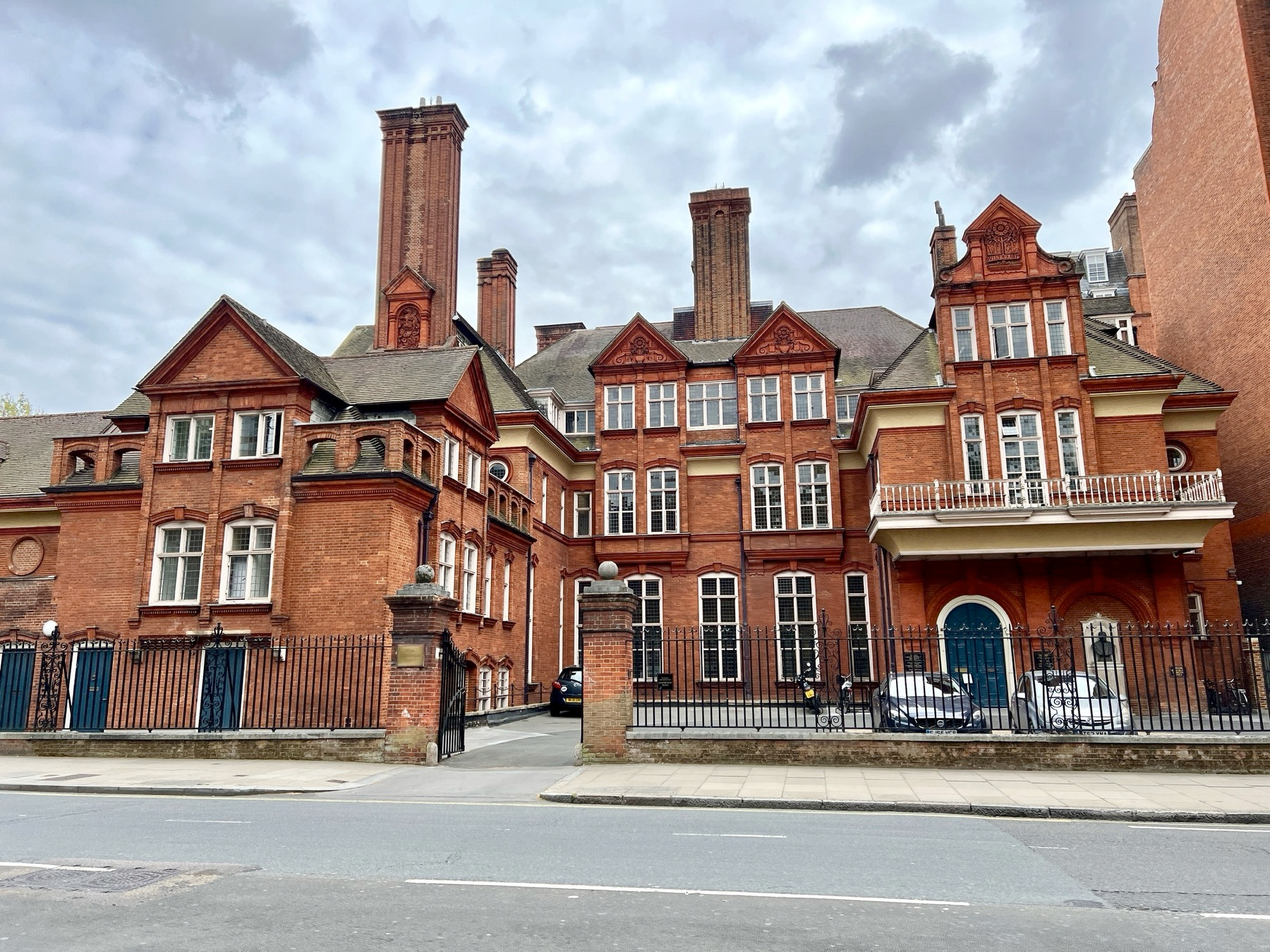
The RGS is located on the south side of Kensington Gardens. Founded in 1830 the massive red brick building has statues of Shackleton and Livingstone adorning its walls. I made my way from South Kensington tube station on a bright spring morning, the clear blue sky giving the whitewashed townhomes of Kensington a glorious sheen. This area of London is quite different to where I stayed in Brick Lane or even the fancy Bloomsbury area. I felt like I would run into Hugh Grant at any moment!
Making my way north to RGS I walked through the grounds of University College London, and past the Natural History Museum with a massive line of tourists spewing out the front like an army of ants eager to enter their nest.
I love the feeling of walking a university campus on a fresh spring day. I eagerly made my way to RGS on the north end of the campus.
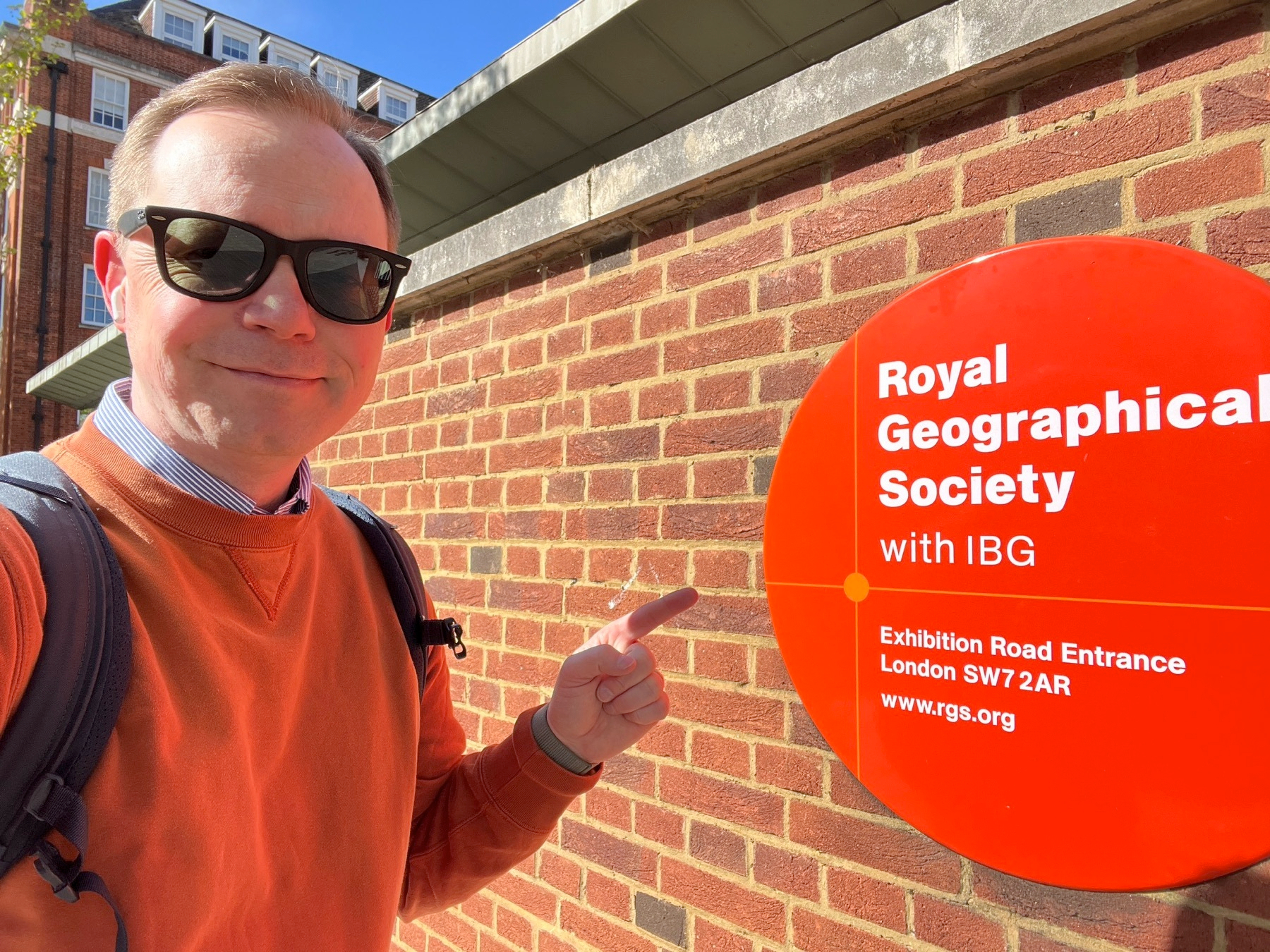
The RGS requires at least 2 weeks notice to pull items for viewing. It has over 2 million items in its care. A month before my trip to London I went through the online index and requested everything Younghusband-related I could find, all for the low cost of £10! On the day I walked down the circular stairs and into the Foyle Reading Room where there was a table laid out like a banquet.
Before I describe the table I should describe the room. The Foyle Reading Room is similar to any other library sub-basement. High windows let in natural light. Copies of guidebooks (eg Lonely Planet) and issues of the Royal Geographical Society’s various publications lined the walls. At intervals busts of people like Gertrude Bell and and Sir Richard Burton are interspersed with globes of different size and era. In one corner there was a stack of massive kris knives. 🤷♂️
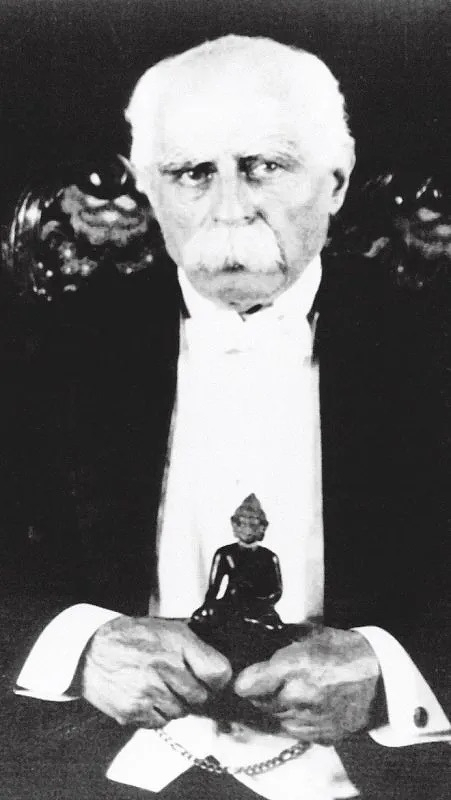
The long table where my treasures awaited was actually divided into three areas (two other researchers would arrive later in the day, one investigating women mountaineers and I never learned what the other one was working on.) At the far end a lightbox embedded into the table illuminated several rows of glass slides with images of the wide Tibetan plains and ancient stone forts on a hill, another with Mount Everest rising up in the background, a mountaineer posing at the foot of massive frozen waterfalls, the Potala palace, and more. Next to that was a stack of old books including copies of the Geographical Journal from over 100 years ago with articles written by Younghusband about his adventures, his 1907 report “Geographical Results of the Tibet Mission”, clear plastic envelopes containing printed photos, and two paper envelopes containing the hand-written journals of Captain Younghusband from 1899. To the right of the books was a map of the mountain passes between modern day China and Pakistan, exactly where I was 20 years ago. In the middle of the table were some physical specimens: two cloudy jade cups, a small replica of the gate to Lhasa awarded to Youngshuband as a congratulatory momento for the Tibet mission, and a small Buddha statue presented to Younghusband by the “regent” of Lhasa upon his exit of the city. That statue is the same one in the photo below, clutched by an elderly Younghusband who was visiting Ottawa for the inaugural meeting of the Canadian Geographical Society in 1929.
The librarians were also kind enough to pull a photo album from someone else in the Tibet mission containing some excellent images of the people and landscape of Tibet at the time, including the entry gate to Lhasa with the Potala Palace in the background.
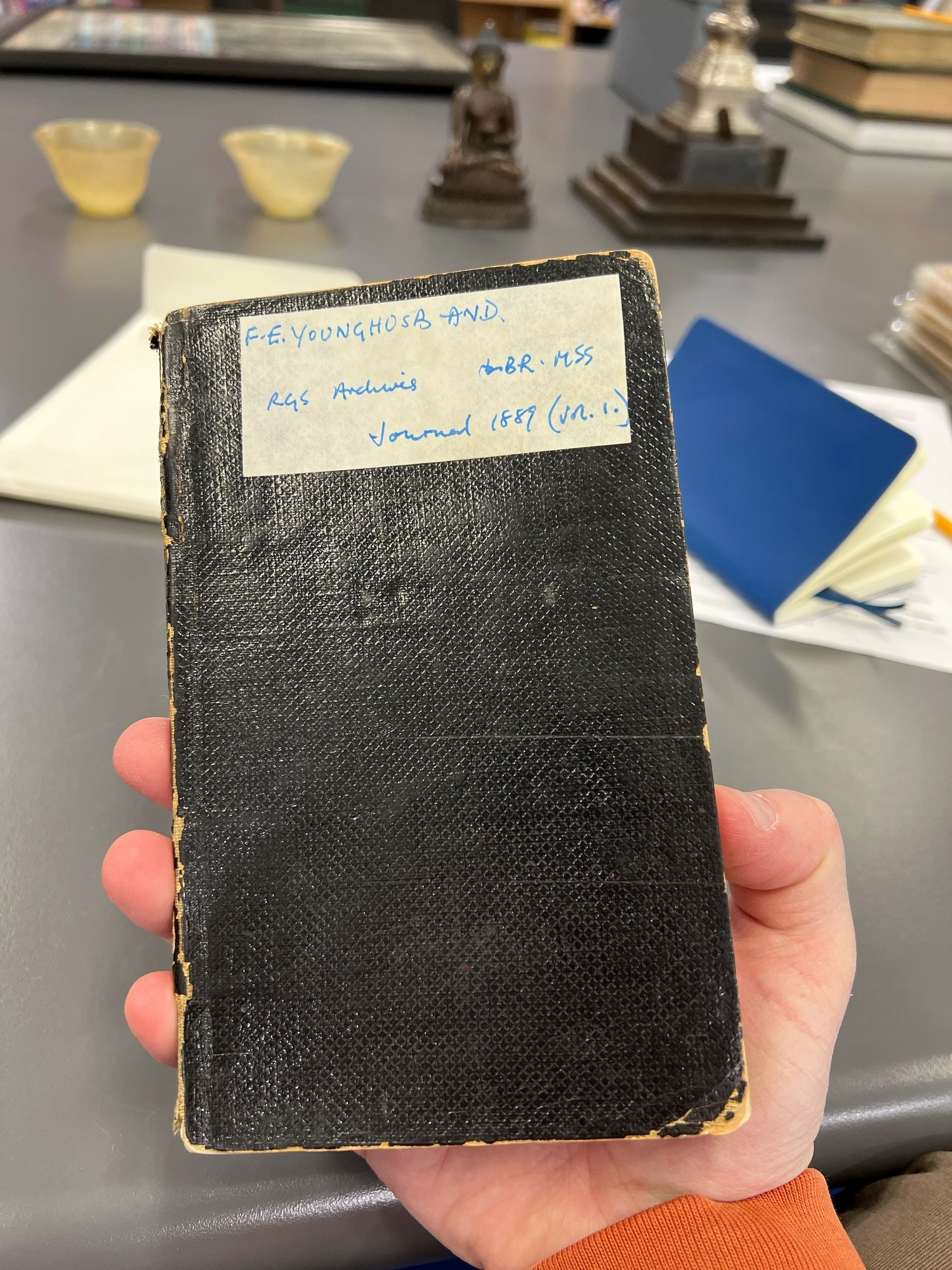
Youngshusband had many adventures: a 1200 mile journey across China; trekking the Changbai Mountains in Machuria; facing Hunza raders in Ladakh; invading Tibet… but I was mostly interested in the time he spent in the Pamirs and wintered in Kashgar, where I was based in 2004. The two hand-written journals from 1889 detailed his crossing to China from India, including the meeting with Gromchevsky noted above. I sat and read every line of these, imagining him scribbling while on horse or camel-back, or in a little tent after a hard day’s ride. They are very readable. Some days have just one line saying that they marched in some bad weather. Other entries are full of details from conversations with local tribal leaders: intelligence gathering for the Great Game. In the middle are a bunch of lists of provisions and at the back, upside down and in the opposite direction of the journals are accounting tables tracking payments to labourers, purchases, and tolls paid. Maybe I am just a nerd, but it was cool to see that kind of “behind-the-scenes” detail. The details of the journal were further enriched by the photos and other articles that I spent the entire day pouring over.
Taking Lunch, taking stock
Halfway through the day I decided to get something to eat. As a guest of the RGS I was able to use the tea room, the staff canteen. Back up the circular stairway I made my way into the historical RGS building, a three story brick mansion that houses a large theatre and a number of rooms with paraphernalia from different expeditions and portraits of famous explorers.
I am somewhat embarrassed to say that I got lost on my way to the tea room (ironic), but eventually found my way to a bright yellow space with a staff refrigerator and nice Russian-sounding lady who got me a soup and a panini. I listened to working geographers sat at wooden tables having lunch and discussing business before retreating back upstairs into areas that I was not permitted to enter, no matter how much I wanted to explore. I ate below a gorgeous photo of the gorge at Petra. Across the room a portrait of James Silk Buckingham dressed in Arab garb loomed over the room.
Afterwards I took a walk outside in the courtyard before returning down into the Foyle Reading Room to finish my studies.
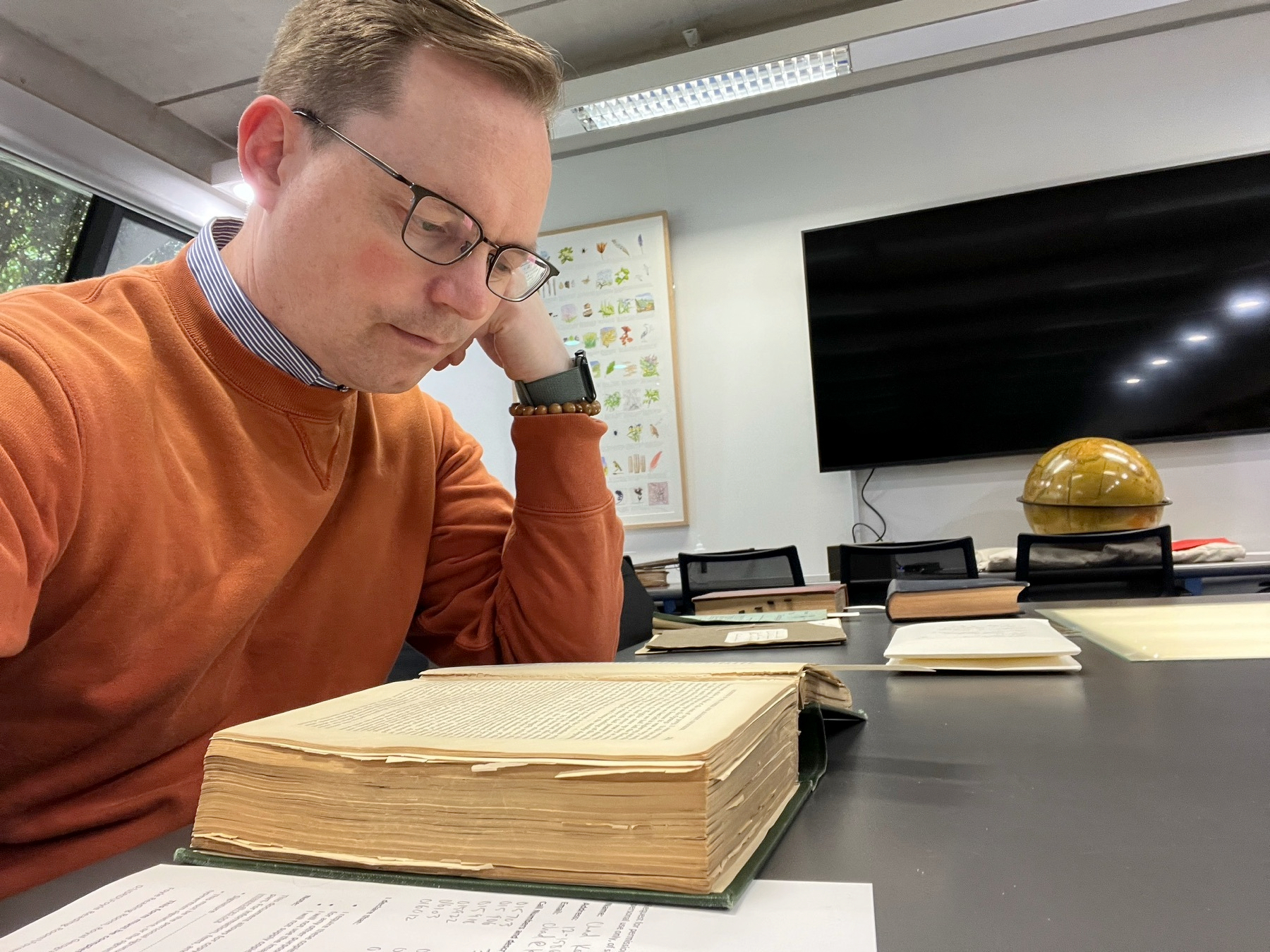
The day at RGS was one of conflicting feelings. On the one hand the absolute nerdy joy of checking off an item that has been on my bucket list for over 20 years was palpable. I took a million photos but signed a promise that I would not post any detailed images of the artefacts online, so unfortunately I cannot share any more details with you.
When I was younger I admired these kinds of explorers with a romantic sense of adventure. Younghusband, Marco Polo, Ibn Khaldun… I read about all their trips. The open road/sea/desert was what drew me.
But actually sitting down to read the thoughts of explorers from those times is… well… there is a lot of imperialism to contend with. As he aged Younghusband became more spiritual, and maybe even more forgiving. But this doesn’t redeem him. And in fact may have just downshifted into Orientalism, fascinated with “the wisdom of the East”.
Previously I have discussed the topic of adventuring and its associated ethical problems. I can admire those brave enough to explore our shared world, as long as they are willing to learn and listen about other peoples and cultures without categorizing or ranking them. We travel because we seek to learn the hearts of others, not to establish hierarchies (I hope! I wish!).
Like the British Museum, the RGS is a wonderful place to learn. But it requires navigating a complex socio-historical reality, something I am still exploring and writing about in journals of my own.
All Photos from RGS

Also, during my last trip to London I spotted some Younghusband items in British Museum