Don’t sleep on Frankfurt
I slept quite a bit in Frankfurt. After two weeks of travel from Toronto to London to a wedding in southwest Germany and then walking Heidelberg, I was pretty tired out by the time I reached the last city in my multi-leg trip. The hotel I picked was the same one from last time I was in Frankfurt. Then I stayed just for one night after my transatlantic flight before quickly transiting to Mannheim, but this time I took an extra couple of days in to explore the city a bit more and meet a friend. The hotel was the same building but under new management with a new brand. At the time I didn’t realize this was a metaphor for Frankfurt itself, which has constantly re-invented itself since the 8th century.
The hotel sits on the Main river, a major strategic waterway bisecting Germany into north and south. It is the Weißwurstäquator, or White Sausage Equator. 😏 The Old Bridge crossing the river hosts a large statue of Charlemagne. I took a photo that looked almost exactly like the one I took two years ago. I have returned! Charlemagne yeah. Good old Karl der Große. You know! Super important historical figure… something to do with Franks… a king… emperor? Wait… who was Charlemagne again?
Having switched to Asian Studies since the tenth grade there are a lot of holes in my European historical knowledge. Fair enough I suppose. I can’t tell you much about the Mali Empire under Mansa Musa either, nor name any specific leaders of Tiwanaku (even though I have heard of Lake Titicaca). Now that I am in the city from which Charlemagne administered the Holy Roman Empire, which he founded, I took some time in my hotel room to catch up on the history of the city while resting up. After being crowned Emperor in Rome by the Pope, uniting Middle Europe, Frankfurt became a major site of governance. From the 14th Century it was the site of imperial elections for the Holy Roman Empire. Charlemagne’s successors would be selected and crowned in Frankfurt for centuries, with coronation feasts held in Römerberg, the cute little town square that has been reconstructed since being destroyed in WWII.
Just a few streets over from the Römerburg is the family home of Johann Wolfgang von Goethe, Germany’s most famous writer. Goethe actually saw an imperial coronation, that of Joseph II, when he was a boy. Goethe’s family home was also reconstructed after the war and is an insight into how an upper class family lived during the turn of the 18th century. (While recovering in my hotel, when I wasn’t learning about the Carolingian empire, I was catching up on Goethe before in preparation to visit Goethe House. What a life!).

📸 See all the images in full screen on Flickr →
Goethe House is attached to a modern museum that covers not only Goethe but the Romantic Era of the late 18th C. Paintings, poetry, philosophy… each floor of the 4 storey museum is packed with ideas from the Romantic Era, a period where German creatives explored nature and society as the scientific revolution of the Enlightenment started categorizing everything, and the Industrial Revolution began turning humans into machines.
It was a cultural counter-reaction that I think we can understand in our era, and I have even written a little about my thinking along these lines in my newsletter. I would like to explore this topic more in the future.
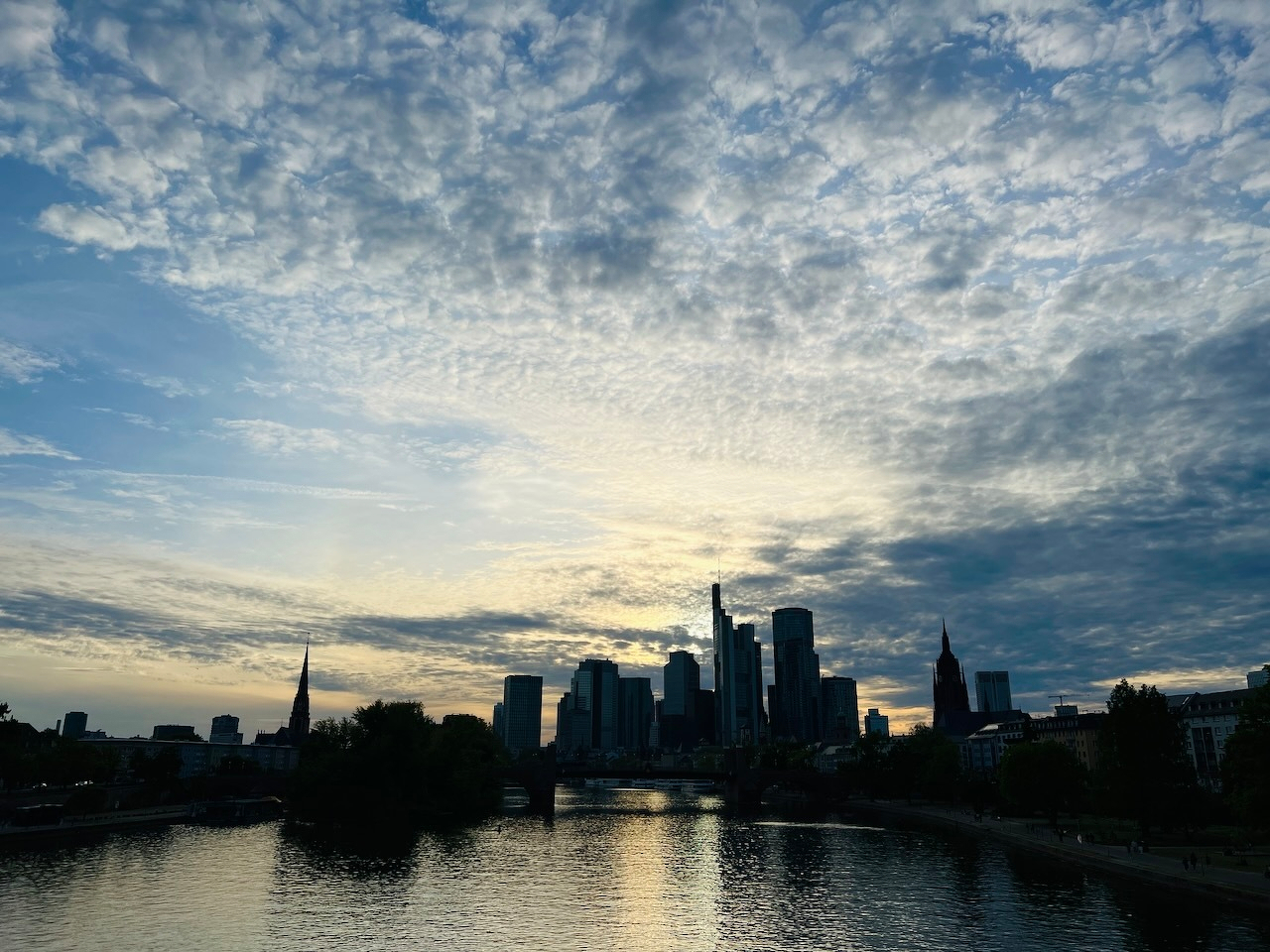
Back at the Old Bridge with the statue of Charlemagne you get a nice evening view of the Frankfurt skyline. This is the economic heart of modern Germany, of Europe even! Frankfurt is home to the European Central Bank and many other financial institutions. The Börse Frankfurt is the world’s 3rd oldest stock exchange and handles 90% of trade activity in Germany.
Between the modern downtown core and the more traditional area are shopping streets and malls and various platze. I turned a corner and ended up in a sort of farmer’s market, with food trucks and stalls pretty much under the shadow of the skyscrapers of downtown Frankfurt. It was a gorgeous sunny day, everyone wore bright green shirts and people were setting up a sort of conveyor belt in the middle of the square. I had no idea what was going on but I stuck around and soon found out it is the Frankfurt Green Sauce Festival.

Boxes of the four different herbs that come into season during spring were carted up and workers lined the conveyor belt, stacking handfuls of each herb onto large squares of brown paper that were rolled up into little bundles like a large burrito to be taken home and turned into green sauce. The surrounding food trucks all sold food with their own take on Frankfurt green sauce. It was a block party with a brass brand, radio and TV stations broadcasting, and I was standing just a couple meters from the Mayor of Frankfurt as he tossed a bundle of herbs over his shoulder into the crowd like bride’s bouquet. What a random event to just wander into!
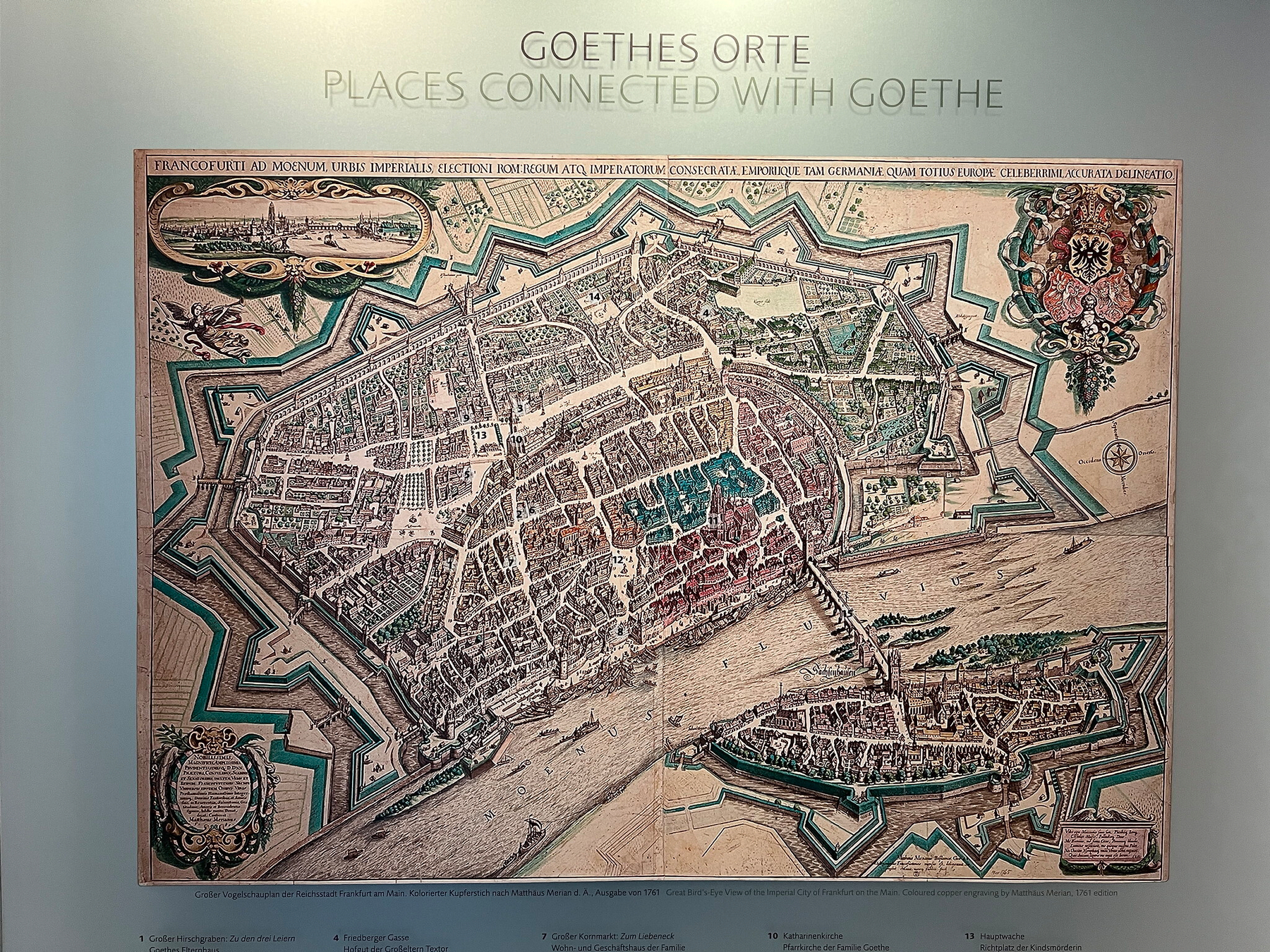
In Goethe House there is a drawing of Frankfurt as a star fortress. Starting in the early 1600s for 200 years this new iteration of wall protected the city. They were finally torn down in the 19th Century and turned into a greenway which I decided to walk on my last day in the city. Through the shopping district to the north gate of the original wall, I took some photos of the Eschenheimer Turm, a 15th C tower built to guard the wall even before the era of the star fortress.
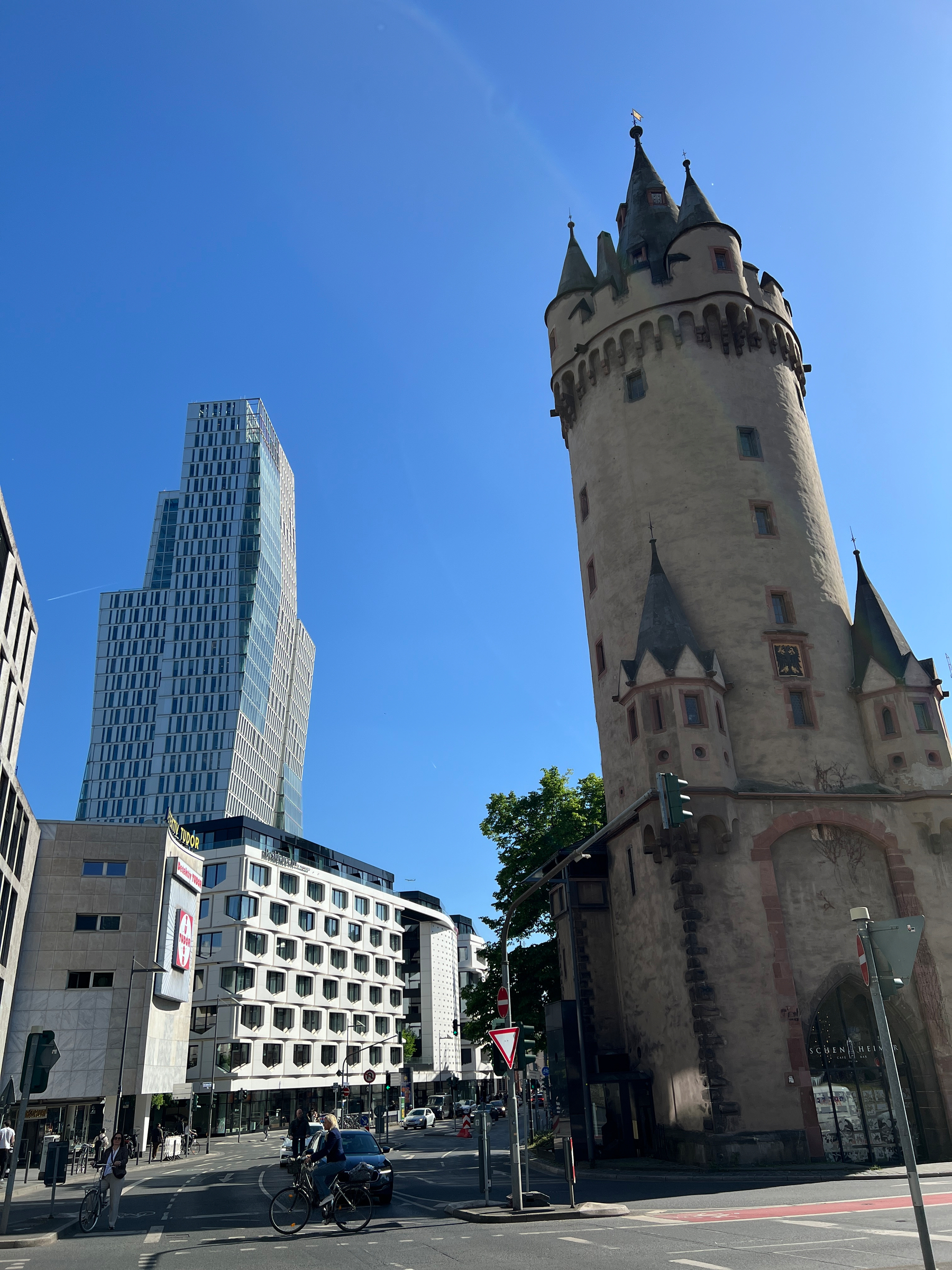
Beyond the turm the curving greenway outside of the downtown core has walkways and bike paths, many shady trees, playgrounds, ponds and public spaces. I enjoyed the final circumnavigation of the city dotted with statues of important figures and the occasional Canada goose wetting its feet in slow moving streams as spring pollen fell from birch and oak trees like a gentle snow on people picnicking and relaxing in the park.
Of all the cities in Germany Berlin is of course the most important and a fascinating place to visit. Most people would list Hamburg and Munich as the next important cities of Germany. Frankfurt is only the fifth largest city, but I would argue that it deserves to be ranked higher in the consideration of visitors. Don’t just treat it merely as the transport hub it admittedly is, but take a couple of days to enjoy this modern centre of European power and its imperial and cultural legacy.